

Inlacin®️ Receives Empowered By Evidence Gold Accreditation for Product-Specific Scientific Evidence
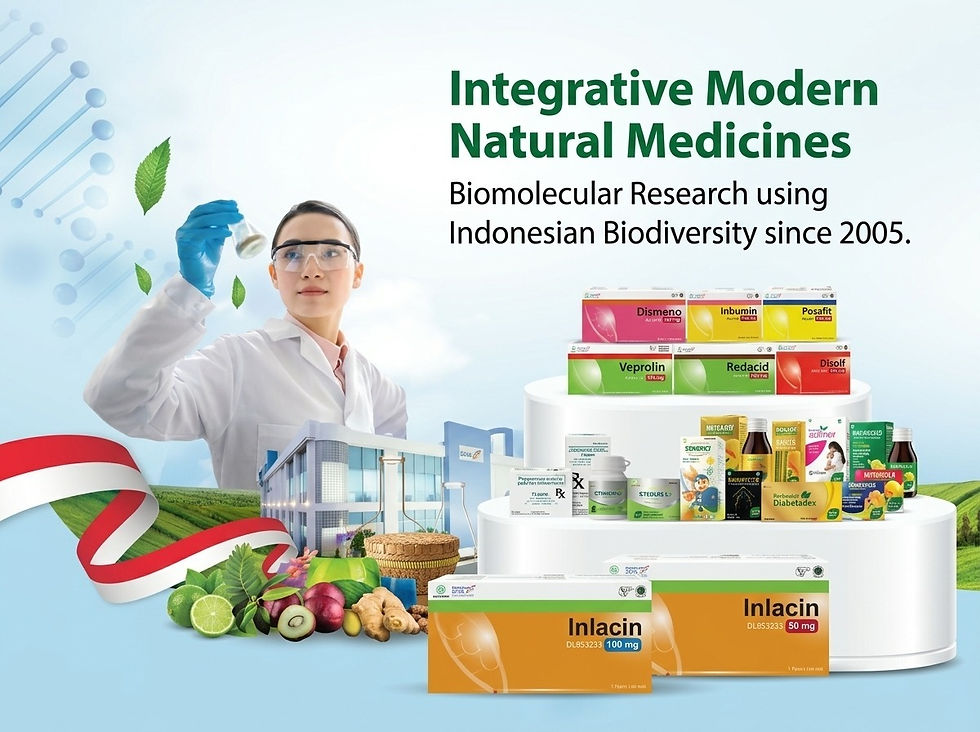
Dexa Laboratories of Biomolecular Sciences (DLBS), the research institution of Dexa Group, announced that Inlacin®️ has received Gold Accreditation from Empowered By Evidence (EBE), following an independent assessment of the product-specific scientific evidence supporting the formulation.
EBE is an independent non-profit organization incorporated in New York that evaluates natural health products based on product-specific clinical evidence and the reproducibility and consistency of the product evaluated in research and made available in the market.
Its accreditation process considers clinical evidence alongside factors including botanical material quality, manufacturing standardization, batch conformity, and product reproducibility.
The Gold Accreditation provides healthcare professionals and consumers with independent assurance that Inlacin®️ is supported by credible, product-specific scientific evidence.
Inlacin®️ (DLBS3233) is a patented, pharmaceutical-grade phytopharmaceutical (Fitofarmaka) that has been evaluated in more than 22 published scientific studies. It is currently marketed by Dexa Medica in Indonesia, the Philippines, and Cambodia, with further international launches planned.
Scientific evidence as the basis of trust
Natural health products are inherently complex. Because they are derived from natural sources, their composition can vary considerably between brands and even between batches of the same product.
Botanical preparations derived from the same plant may differ depending on the source material, extraction process, manufacturing controls, and standardization. This makes evidence generated on the specific finished product particularly important.
EBE addresses this by assessing clinical trials conducted on the specific product together with data supporting product reproducibility and quality equivalence.
“Making truly science-based choices in natural health is extremely challenging,” said Nigel Pollard, Chair of the Board of Directors of Empowered By Evidence. “Independent evaluation, transparent education, and access to product-specific evidence are essential. Our product accreditation is a simple way for consumers or healthcare professionals to identify the exact products shown to deliver results in clinical trials.”
Professor Theo Dingermann of Goethe University Frankfurt, Germany, said the value of accreditation lies in who conducts the assessment.
“Trust in natural medicines cannot rest on tradition or reputation alone; it has to be earned product by product,” Professor Dingermann said. “What makes EBE accreditation meaningful is that it is awarded by assessors with no commercial stake in the outcome, against published criteria applied consistently to every applicant. For prescribers and consumers alike, that is a credential they can rely on without having to reconstruct the evidence for themselves.”
PCOS through a hormonal and metabolic lens
The accreditation comes during an important evolution in the scientific understanding and terminology of a condition long known as polycystic ovary syndrome (PCOS).
The new terminology, polyendocrine metabolic ovarian syndrome (PMOS), is intended to better reflect the interconnected endocrine, metabolic, and ovarian features of the condition, including the role of insulin resistance in many patients.
During the transition to the new terminology, PCOS and PMOS may continue to be referenced in parallel across scientific literature, clinical practice, and healthcare communications.
This broader endocrine-metabolic perspective is relevant to the research program behind Inlacin®️, an evidence-based natural medicine developed by DLBS from the standardized bioactive fraction DLBS3233.
Inlacin®️ has been clinically studied in insulin resistance and impaired glucose metabolism, including research involving women diagnosed under the previous PCOS terminology.
“The evolving scientific understanding of PCOS highlights the importance of looking at the condition through an integrated endocrine and metabolic perspective,” said Prof. Raymond Tjandrawinata, Executive Director of DLBS. “This is relevant to the scientific rationale behind Inlacin®️, whose development program has investigated insulin sensitivity together with metabolic and reproductive parameters.”
Clinical research on DLBS3233
The clinical evidence supporting DLBS3233 includes a randomized, double-blind, controlled six-month study involving 124 women with insulin resistance and PCOS.
The study evaluated DLBS3233 100 mg once daily compared to metformin extended release 750 mg twice daily.
Both groups, metformin and DLBS3233, showed significant improvements from baseline in insulin resistance, as measured by the Homeostatic Model Assessment for Insulin Resistance (HOMA-IR), with generally comparable effects across evaluated metabolic and reproductive parameters.
Importantly, the prespecified statistical test for non-inferiority was inconclusive, and the findings should therefore be interpreted within the full study design and clinical context.
The study also reported a lower incidence of adverse events in the DLBS3233 group than in the metformin extended release group, with most events described as mild and resolved by the end of the study.
These findings form part of a broader research program evaluating DLBS3233 in prediabetes, type 2 diabetes, insulin resistance, and endocrine-metabolic health.
Inlacin®️ acts as an insulin sensitizer, supporting the body's natural ability to respond to its own insulin and helping glucose move from the bloodstream into cells where it is used for energy. Clinical studies have observed support for glucose management with a low risk of hypoglycaemia.
Because insulin resistance can also contribute to hormonal disturbances, improving insulin sensitivity may help support a more balanced hormonal profile and menstrual regularity in women with PMOS.
Raw materials and manufacturing
Inlacin®️ is produced using standardized botanical materials derived from cinnamon (Cinnamomum burmannii) and bungur (Lagerstroemia speciosa).
DLBS applies controlled extraction, fractionation, standardization, and pharmaceutical manufacturing processes designed to maintain consistency between the formulation evaluated in clinical research and the product supplied to healthcare markets.
Independent assessment of this connection between clinical evidence and the marketed formulation is central to the EBE accreditation model.
EBE evaluates product characteristics including the quality of plant material, standardization of manufacturing processes, batch conformity, and the status of clinical trial data for the particular product.
“Independent evaluation is especially important in natural medicine, where ingredient-level claims are often presented without demonstrating that the marketed formulation is the same product that was clinically studied,” said Dr Evelyn Wolfram, Lecturer at Zurich University of Applied Sciences, Switzerland. “The assessment of Inlacin®️ examined the depth and robustness of its product-specific evidence, together with manufacturing consistency and reproducibility.”
How EBE assesses products
EBE's global expert team has developed an independent, robust, and transparent accreditation process for natural health products. Products that reach the accreditation standard have been specifically tested in clinical trials and have demonstrated that current batches are equivalent to those used in the trials.
Based on documentation submitted by manufacturers, independent experts review product characteristics including the quality of plant material used for extract production, standardization of manufacturing processes to ensure acceptable batch conformity, and the status of clinical trial data for the particular product.
The product accreditation process is overseen by EBE's Expert Advisory Board. Independent product assessors are appointed based on relevant expertise and have not worked with the product or its competitors for at least three years.
EBE does not sell natural health products or ingredients, does not provide consulting services to brand owners, and receives no direct financial gain related to sales of accredited products.
Indonesian natural medicine for global markets
The EBE Gold Accreditation supports DLBS' long-standing commitment to advancing evidence-based natural medicines through modern bioscience, standardized manufacturing, and clinical validation.
The recognition is also part of Dexa Group's effort, through DLBS, to bring Indonesian scientific capability and biodiversity-based pharmaceutical innovation to international healthcare audiences.
The cinnamon and bungur used in Inlacin®️ are sourced in part from farmers around Mount Kerinci, Jambi. From this Indonesian biodiversity, DLBS developed Inlacin®️, which is now marketed in Indonesia, the Philippines, and Cambodia, with further international launches planned.