

Jakarta – In less than six months, Indonesia’s pharmaceutical industry landscape is set to change significantly. Starting October 17, 2026, all natural medicines, quasi-drugs, and health supplements distributed across the country must be halal-certified. For Indonesia’s 246 million Muslims—representing 87.08% of the national population, according to the Directorate General of Population and Civil Registration at the Ministry of Home Affairs—this deadline marks a new era: halal assurance is becoming a national healthcare standard.
For some industry players, this deadline may feel urgent. For Dexa Group, however, it serves as validation of work that has been underway for the past eight years.
Since 2018, Dexa Group has positioned halal as an integral part of its quality system—embedded throughout every stage of operations, from upstream to downstream. Today, Dexa Group’s entire portfolio—more than 1,700 products—has obtained halal certification and is distributed to over 13,000 healthcare facilities across Indonesia. This achievement is the result of countless deliberate decisions made in research laboratories, production floors, and distribution warehouses, consistently upheld by thousands of employees for nearly a decade.
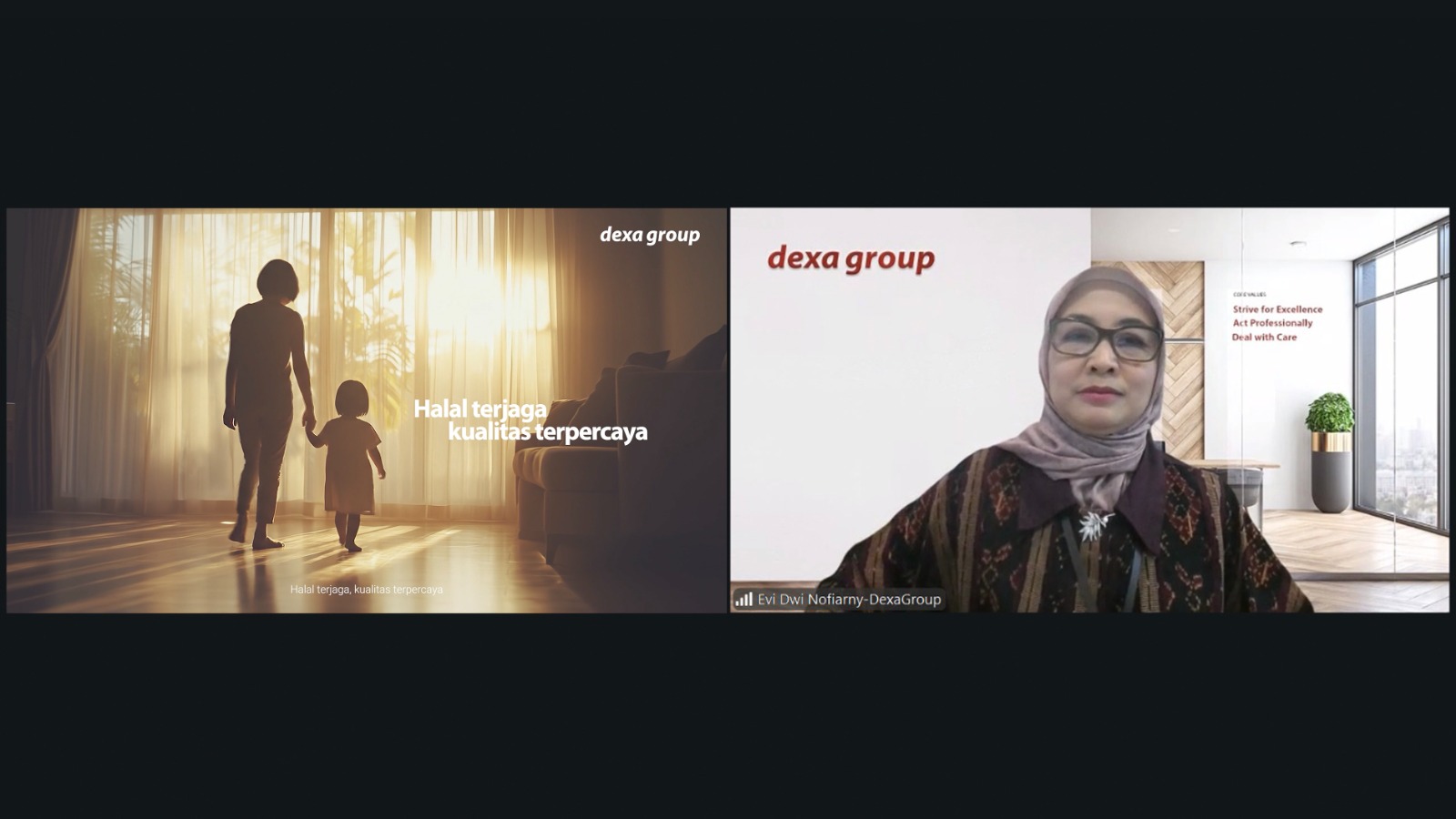
The philosophy behind this commitment was clearly articulated by Apt. Dwi Nofiarny, S.Si., M.Biomed, Head of Corporate Quality Audit & Pharmacovigilance at Dexa Group, during the Webinar Road to International Islamic Healthcare Conference & Expo (IHEX) 2026 in Jakarta on April 24, 2026. “Halal must be built from the very beginning. From research, raw materials, production, to distribution—everything must be fully controlled,” she stated.
This approach is known as halal by design—integrating halal considerations from the research and development stage, long before products enter mass production. For R&D teams, this means selecting raw materials with halal traceability from the outset. For manufacturing teams, it means running halal management systems in parallel with Good Manufacturing Practice (GMP). For distribution teams, it means safeguarding halal integrity until products reach pharmacists and patients.
Indonesia’s national regulatory framework now rests on two key pillars: Government Regulation No. 42 of 2024 on Halal Product Assurance Implementation and Presidential Regulation No. 6 of 2023 on Halal Certification for Medicines, Biological Products, and Medical Devices. Implementation is being phased by product category. Following the October 17, 2026 deadline for natural medicines and health supplements, over-the-counter and limited over-the-counter medicines must comply by October 17, 2029, followed by prescription medicines—excluding psychotropics—by October 17, 2034. Biological products and Class D medical devices face a final deadline of October 17, 2039.
This policy places halal assurance on equal footing with quality, safety, and accessibility within Indonesia’s national healthcare system. At the same time, it introduces new operational challenges for the pharmaceutical industry.
Supply continuity has emerged as one of the industry’s greatest challenges after certification is obtained. When halal-certified products go out of stock, the consequences can ripple across the healthcare system: treatment options become limited, hospital clinical pathways are disrupted, and patient trust may erode. Dwi Nofiarny emphasized, “Halal assurance must go hand in hand with supply assurance, so healthcare services remain uninterrupted.”
A similar perspective is shared by the hospital sector. Dr. Mulyadi Muchtiar, MARS, President Director of YARSI Hospital, framed halal medicine supply within a broader healthcare governance paradigm. “Sharia hospitals represent a new paradigm—not merely an Islamic label, but a comprehensive governance system that interoperably integrates modern medical quality with maqasid al-shariah values,” he explained. Within this model, halal medicines are incorporated into clinical pathways and serve as the standard of care, except in emergency situations. Reliable supply is therefore essential for maintaining the integrity of sharia hospital governance systems.
This is where the strength of halal by design becomes especially evident. Because halal principles are integrated from the upstream stages, Dexa Group is able to respond to fluctuations in raw materials and distribution while maintaining consistent product availability. The system established since 2018 enables Dexa Group’s medicines to remain reliably available across thousands of hospitals, clinics, and pharmacies—including sharia hospitals where halal medicines are part of standard clinical pathways.
This consistency has been recognized repeatedly by national halal authorities. In 2019, HerbaKOF—an integrative modern natural medicine (OMAI) in the standardized herbal medicine category—received a Halal Award from LPPOM MUI. In 2020, LPPOM MUI recognized Dexa Group as a pioneering halal product company for its consistent implementation of the Halal Assurance System in the Medicine & Supplement category. In 2022, Indonesia’s Ministry of Industry awarded Dexa Group the Indonesia Halal Industry Award (IHYA) for Best Halal Innovation. In 2023, Dexa Group received the Halal Award for Best Social Contribution on Halal Ecosystem, while Anugrah Argon Medica received the Halal Award for Best Halal System Implementation, both from LPPOM MUI. In 2024, Dexa Medica earned the IHYA award for Best Halal Supply Chain from the Ministry of Industry. This recognition culminated in 2025 when Dexa Group received two prestigious awards in a single day: the Corporate Halal Leadership Award from LPH LPPOM in the Innovation, Research, & Development category, and the IHYA 2025 award from Indonesia’s Ministry of Industry for Dexa Medica as the Best Halal Pharmaceutical and Traditional Medicine Company.
This track record serves as the foundation of Dexa Group’s communication campaign: Dexa, Halal Integrity, Trusted Quality. The campaign represents a promise fulfilled every day through the collective dedication of employees across six production facilities, all fully certified under the Halal Assurance System—Dexa Medica in Palembang and Cikarang, Ferron Par Pharmaceuticals and Fonko International in Cikarang, Beta Pharmacon in Karawang, and Anugrah Amartha Global in Bogor.
This achievement carries an important message for every Dexa Group employee. Halal certification across more than 1,700 products reflects the work of every division living the company’s core values each day: Act Professionally by selecting traceable raw materials, Strive for Excellence by building quality systems that exceed minimum regulatory standards, and Deal with Care by ensuring every product reaching patients meets its promised standards.
Indonesia is home to the world’s largest Muslim population. As the 2026 deadline approaches, the national pharmaceutical industry will be measured by who is prepared and who is left behind. For Dexa Group, the answer has been written since 2018—one product, one certificate, one commitment at a time. Halal integrity, trusted quality. In a Muslim-majority nation, halal assurance is more than compliance—it is a responsibility collectively carried by every employee behind every Dexa product.