

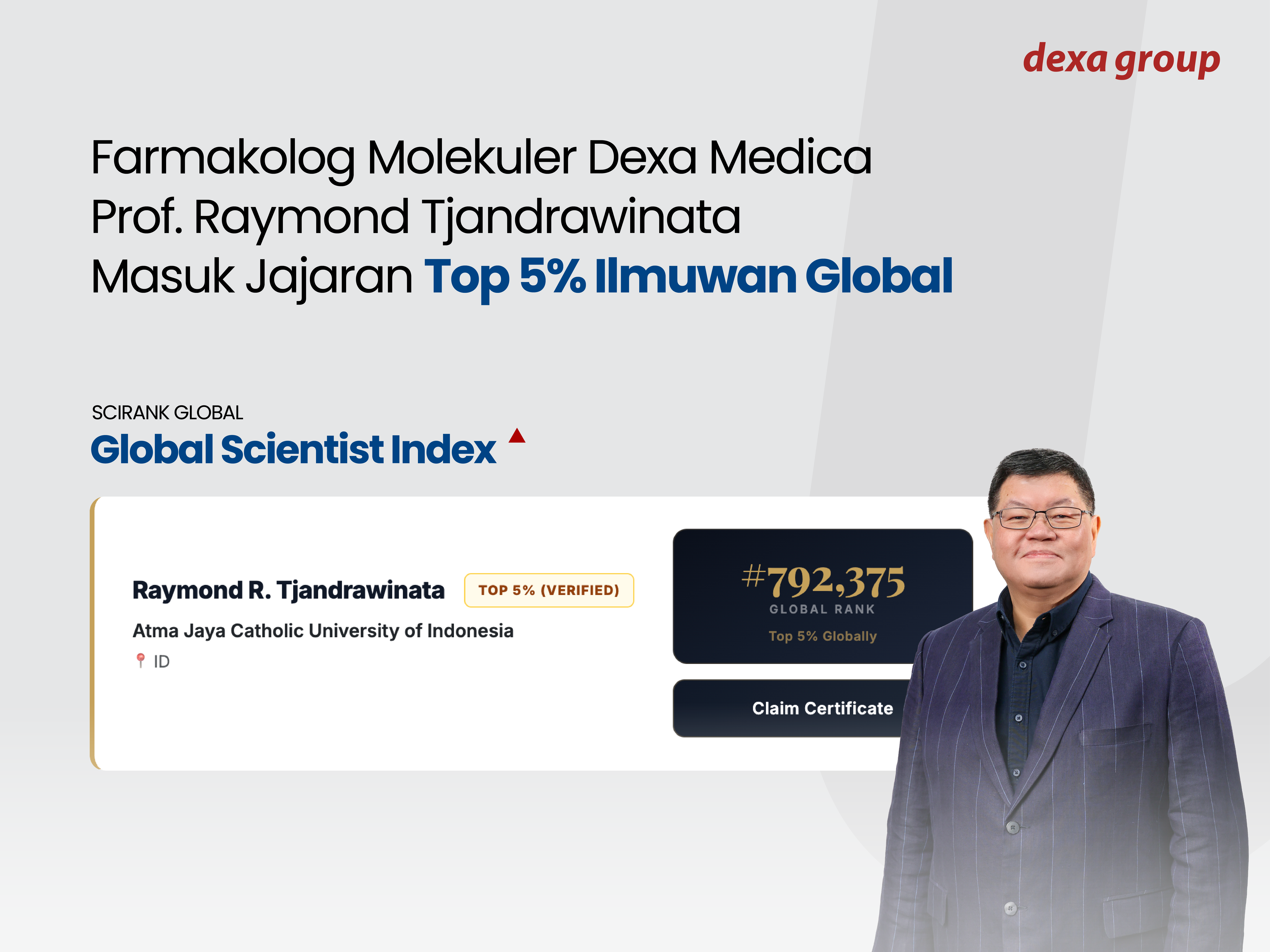
JAKARTA — Prof. Raymond Tjandrawinata, Molecular Pharmacologist at PT Dexa Medica, has been ranked among the Top 5% of Scientists Globally by the SciRank Global Database. The recognition follows an extensive evaluation of more than 8 million researchers, 20 million scientific publications, and academic data from over 150 countries.
“I receive this recognition with deep gratitude. Behind every publication, patent, and scientific achievement lies the dedication of many researchers, collaborators, and mentors who have contributed throughout the years. For me, the ultimate purpose of research is to generate knowledge that improves human lives,” said Prof. Raymond.
SciRank is a global scientific ranking platform that evaluates millions of researchers from around the world based on the impact and productivity of their scholarly work. The ranking is determined through the analysis of multiple bibliometric indicators, including publications, citations, research impact, and academic influence within the global scientific community. Through its data-driven methodology, SciRank provides insight into a researcher’s contribution to scientific advancement and serves as an important reference for measuring research competitiveness on an international scale.
This latest achievement adds to a growing list of international recognitions received by Prof. Raymond throughout his more than three-decade career in biomedical sciences, molecular pharmacology, and pharmaceutical innovation. In the AD Scientific Index 2026, he was also ranked among the top 3% of researchers globally.
Behind these rankings lies a long and distinguished scientific track record. In the early 1990s, Prof. Raymond participated in NASA’s Spacelab Life Sciences program, which investigated the effects of microgravity on the human body. As scientists sought to understand the mechanisms behind bone loss experienced by astronauts during space missions, he was part of the research team working to uncover the answers.
The experience provided him with access to a world-class research ecosystem. Yet it was after experiencing the international scientific environment firsthand that Prof. Raymond recognized the immense research potential of Indonesia. In his view, Indonesia possesses a unique advantage that few countries can match: extraordinary biodiversity that remains largely untapped as a source of healthcare innovation.
This conviction eventually led him to join Dexa Medica. At a time when many domestic pharmaceutical companies were primarily focused on manufacturing, Prof. Raymond championed the strengthening of research as the foundation of innovation. Through the Dexa Laboratories of Biomolecular Sciences (DLBS), he and his team began exploring Indonesia’s rich biodiversity to develop healthcare products grounded in rigorous scientific evidence.
The journey was far from short. Years of research, testing, scientific validation, and regulatory processes were required before these innovations could reach patients. That long-term commitment resulted in a series of breakthroughs that later became known as Integrated Natural Modern Medicines (OMAI). These products were developed through research on Indonesia’s biodiversity, combined with the principles and methodologies of modern molecular pharmacology.
His scientific contributions have continued to expand. To date, Prof. Raymond has authored more than 400 international scientific publications, which have collectively received over 5,300 citations from researchers worldwide. More than 2,800 new citations have been recorded within the past five years alone, demonstrating the continued relevance and influence of his research within the global scientific community.
This productivity is also reflected in widely recognized academic performance indicators. According to the AD Scientific Index 2026, Prof. Raymond holds an H-index of 37 and an i10-index of 112. In the same ranking, he is placed third nationally in Pharmacy & Pharmaceutical Sciences and 19th in Indonesia in Medical and Health Sciences.
Beyond scientific publications, his contributions are also evident in innovations that have been translated into intellectual property. To date, Prof. Raymond holds 64 patents registered in Indonesia and internationally. Several of these patents have served as the foundation for healthcare products marketed both domestically and globally.
Recognition of these contributions continues to grow. In 2026, the Museum Rekor-Dunia Indonesia (MURI) honored him as the Indonesian researcher with the highest number of Scopus-indexed publications and patents in interdisciplinary biomedical sciences. The award highlights how scientific productivity can go hand in hand with innovation that delivers tangible benefits to society.
Notably, Prof. Raymond’s academic journey continues. Alongside his responsibilities as Business Development and Scientific Affairs Director of PT Dexa Medica, he remains actively engaged in research while pursuing doctoral studies in law. His current academic focus includes intellectual property rights, healthcare regulation, and pharmaceutical innovation. For him, scientific advancement, regulatory frameworks, and public access to healthcare technologies are interconnected elements within a broader innovation ecosystem.
Prof. Raymond Tjandrawinata’s inclusion among the world’s top 5% of scientists serves as a reminder that meaningful innovation often begins with a simple choice: to return, to build, and to persevere. From NASA laboratories to the development of biodiversity-based pharmaceutical innovations in Indonesia, his journey demonstrates that science originating in Indonesia can make a significant impact on the global stage.
Most recently, in 2026, Prof. Raymond published a bilingual book in both Indonesian and English titled System Shift: Reading the World as Structure in Motion. In this work, he introduces a new framework for understanding global change, arguing that major transformations rarely occur suddenly. Instead, they emerge through gradual structural shifts that become visible over time. The perspective is particularly relevant in today’s environment of growing global uncertainty, geopolitical fragmentation, rapid advances in artificial intelligence, institutional challenges, and economic pressures that are unfolding simultaneously around the world.